Potatoes in Your Socks
The MAHA agenda and its unexpected connection to ancient Greek philosophy

It’s been a busy time on the public health front: new NIH interest in miasma, the ongoing weird preoccupation with Ivermectin, Ralph Abraham’s appointment as HHS deputy secretary, the current FDA take on coronavirus vaccines for kids, and new recommendations from the Advisory Committee on Immunization Practices.
We’ll get back to all of these with more detail in the weeks to come. But first, let’s talk about potatoes.
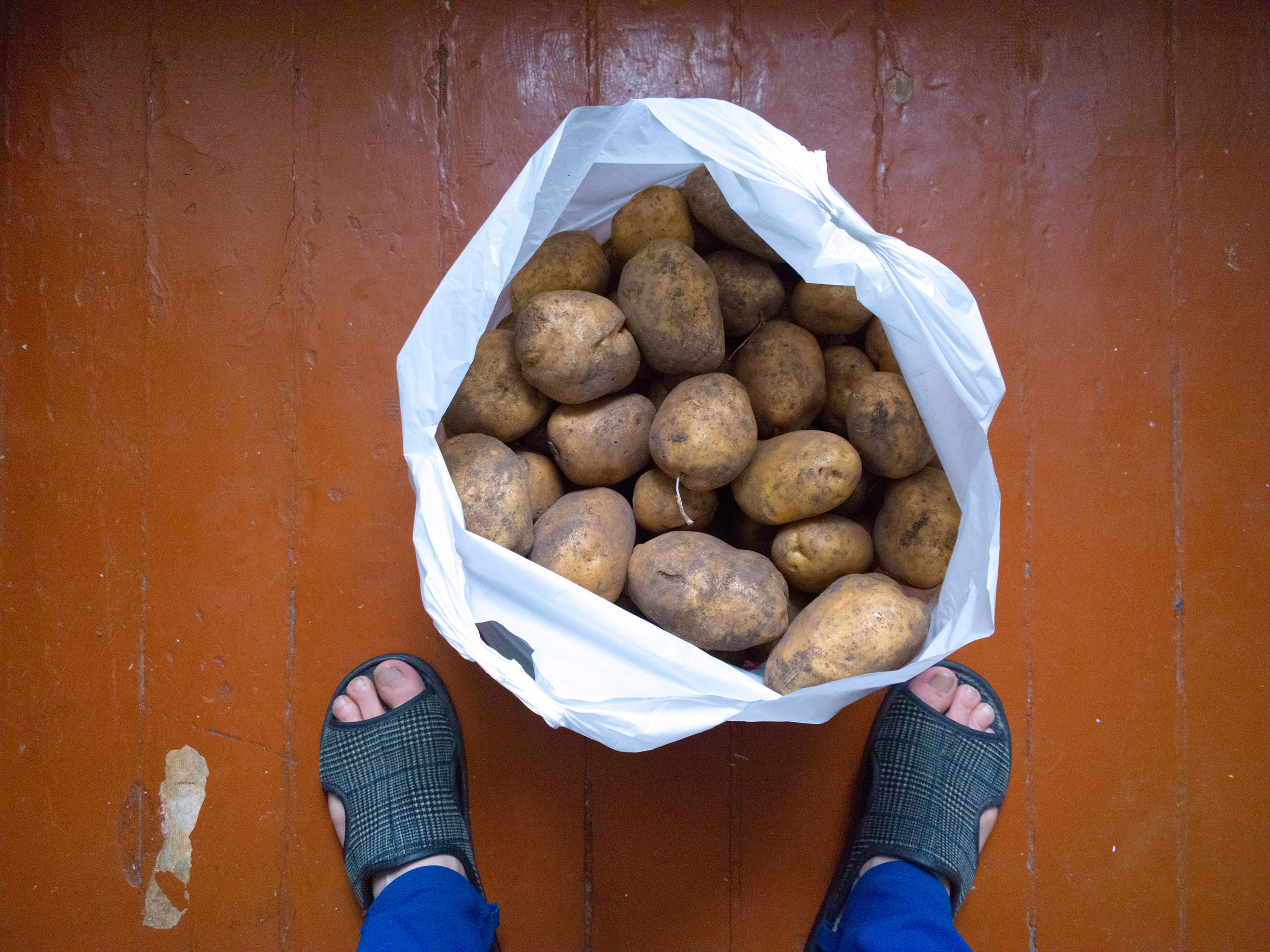
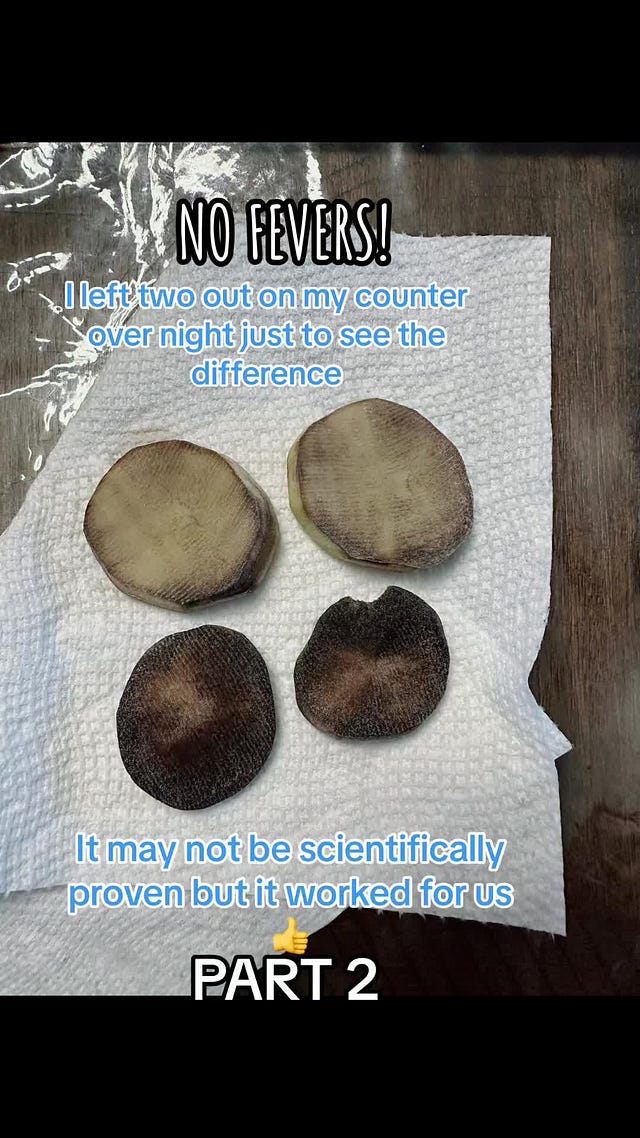
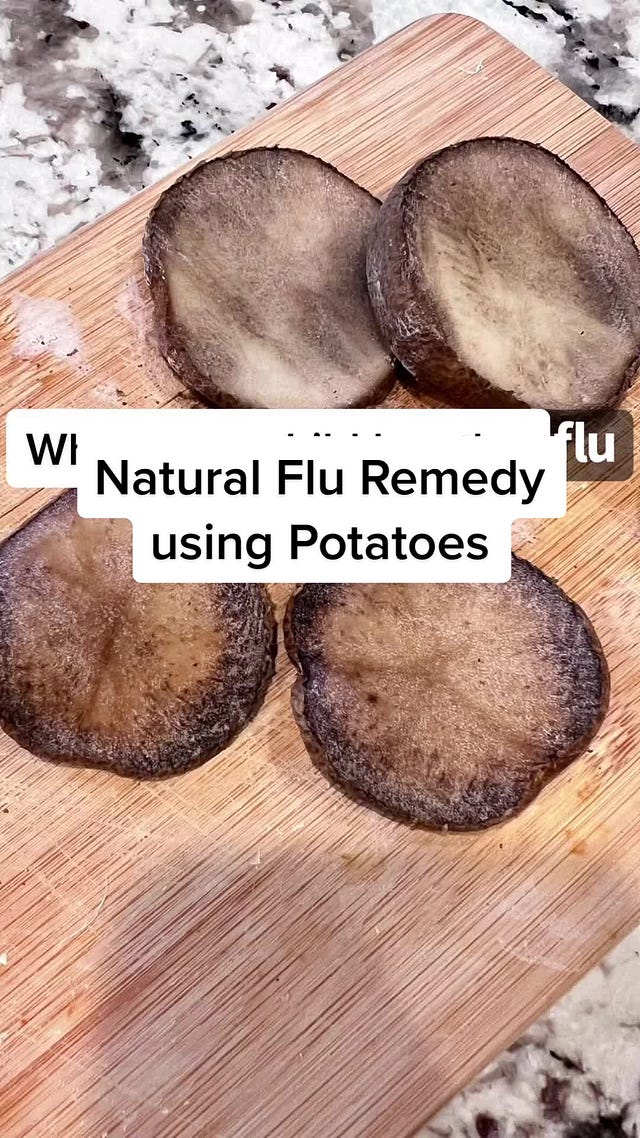
It’s gone viral on social media: for a cold or flu, slice potatoes, stuff them down into your socks so that they rest on the soles of your feet, and wait for them to draw out the toxins in your body. “One of us has Flu A and he feels much better this morning!” one TikTok mom exulted. “I did this last night and feel so much better!” another enthused. And a third influencer, overwhelmed by the transformation of the potato slices into dark wrinkled blobs, sobbed, “I am in shock and tears” (presumably over all the poison being sucked out through the soles of her feet).
The trend didn’t go unchallenged, of course. Plenty of doctors and pharmacists weighed in to say that potatoes can’t actually draw anything out of your body through the skin, that any lessening of cold and flu symptoms simply had to do with the disease’s natural progression, that the blackening of the slices was just caused by exposure to air and body heat, and that a much better use of potatoes would be to fry them up with salt and pepper in a little browned butter. But none of this made much difference. The TikTok train rolled on.
The potato-in-sock trend reveals something foundational to the MAHA worldview—something that has informed all of those public health developments I listed above.
The clue here is “toxins.” What exactly is a toxin? Well…as it turns out, the term is rarely defined by those who use it (and by those who market ways to remove said “toxins”). It’s a catch-all for “bad things that make our bodies worse.”
Of course, we do ingest bad things: pesticide residue, for example, or airborne chemicals, or tar from cigarettes. Possibly, as we’re now learning, too many microplastics.
But wellness fans who chat blithely about toxins almost never specify exactly what the toxins in question are. The various trends for getting rid of these generic poisons—whether juice cleanses, colonic irrigations, sweats, various herbal pills, or potatoes in the socks—rarely explain how the cleansing works.
In part, that’s because our bodies already have a perfectly good system for filtering out toxins: five major organs (that would be liver, kidneys, lungs, colon, and skin) which are more effective than any external process. But in larger part, it’s because we live in a world which, for two centuries, was shaped by a Greek theory about what perfect health looks like—and about what threatens that health.
For a moment, let’s go back to the beginning, as the Greeks saw it.
In the begining was a Golden Age, the First Age, a time of simplicity and perfection and happiness, when war and disease were unknown. It was a time of perfect balance. And then, over time, mankind degenerated and strayed from this balance into dysfunction and chaos.
The Greeks were hardly alone in this foundational myth. Most cultures have an ancient story that resembles this one. But for our purposes, please note that this was the assumption of the great Greek physician Hippocrates, founder of the system of medicine that dominated Western culture for two thousand years (until the discovery of the germ, in fact).
Hippocrates modelled his understanding of the human body on his understanding of the universe. Just as humanity originated in perfection and bliss, so the bodies of infant humans are originally perfect: filled with life-generating heat, positioned for growth and flourishing, all four humours balanced. And then, as the child grows, the outside world begins to batter against it. External elements—hostile winds, bad waters, damaging foods, poisons of all sorts—push the humours out of balance. The body of the young adult, the middle-aged man, the old woman are constantly fighting against those external threats.
Because for the Greeks, the body wanted to be in balance. It wanted to be healthy, like the world at its inception. It was born perfect; everything afterwards was a decline. But the Greeks believed that they had some control over the decline of the body (unlike the decline of the entire universe, which was inevitable). They could manage those outside influences. It was the job of the Hippocratic physician to recommend defenses—ways to rebalance the humours, to ward off the attacks.
Ways to fight off the toxins.
In the eighteenth century, long-distant but direct heirs of the Hippocratic tradition, doctors called those outside influences that unbalanced the humours “non-naturals”: those factors that pushed the body to deviate from its original (natural) perfect state of health. Our idea of non-naturals is in more or less a straight line from our recent ancestors. Whereas the ancient Greek or eighteenth-century British physician would have identified excess heat, or too-rich food, or close city air, as a “non-natural,” in the technologically advanced twenty-first century, we have a more literal sense of what a non-natural is. It’s a chemical or manufactured element. It doesn’t belong in the body. It’s a toxin. Further definition unnecessary.
So how about those potatoes?
They’re natural. In, of course, a wider and sloppier sense than the Greeks or the physicians of previous centuries would have used the term. But the central idea holds. Those things that upset the body’s perfect balance are non-naturals. We can’t fight them with more “non-naturals” (think, antibiotics, injected vaccines). The potatoes are a quirky, irrational outworking of trusting nature over artifice and science, the organic over the external. They’re a Hippocratic solution to a modern problem.
They don’t actually work, of course. Potatoes have no power to extract “toxins” from the body. More to the point, they have no effect on a cold or flu virus, or on a bacterial infection.
But poke around in wellness culture for even half an hour, and you’ll notice that germs are almost invisible. Germs don’t have any place in this natural/non-natural schema. They aren’t “non-naturals” because they exist organically in nature. (In case you’re wondering why so much of MAHA insists that COVID-19 was made in a lab, that’s why: it puts the pandemic squarely in the non-natural category.)
And in many cases, the most virulent germs can only be resisted with vaccines, which are the very definition of non-natural. Not only do they contain manufactured elements, but they are given to those perfect, heat-generating infant bodies that the Greeks so revered.
So the potato-in-sock craze is a useful pointer towards the unstated, foundational assumption of the MAHA world, including its disregard of medical interventions, its suspicion of germs, and its constant question of “non-natural” solutions. Even those that have been shown to save lives.
A couple of potato-in-socks accounts for your viewing pleasure:
 Tiktok failed to load.
Enable 3rd party cookies or use another browser
 Tiktok failed to load.
Enable 3rd party cookies or use another browser
Should you wish to find out more about the original non-naturals: https://www.routledge.com/Lifestyle-and-Medicine-in-the-Enlightenment-The-Six-Non-Naturals-in-the-Long-Eighteenth-Century/Kennaway-Knoeff/p/book/9781032400327
A classic and readable work on Greek conceptions of the universe, aging, and death: John Bagnell Bury, The Idea of Progress, https://www.google.com/books/edition/The_Idea_of_Progress/POzQAAAAMAAJ
Oh the Greeks and the long arm of their influence. Thank you for this lovely synopsis of the human desire for nature over all, even to our own harm. Can’t wait to read your latest book.