Pyramids in Washington
What the Trump building spree tells us about his power

While Donald Trump merrily crashes through all sorts of political traditions, upending them, destroying them, and dismissing them as unimportant, he’s aligned himself sturdily with one of the oldest political traditions of all. It’s one that has been more often exercised by kings and emperors than by democratically elected leaders, but Trump has embraced it.
Building a giant ballroom to replace the wrecked East Wing. The renaming of the Kennedy Center after himself (and lobbying to have both Penn Station and Dulles International Airport named after him as well). Constructing the proposed Triumphal Arch, which Trump has declared must be not just the biggest in the United States, but the biggest in the world. Fingering 45 historic buildings in DC for demolition and reconstruction under Trump’s direction.
It’s all very Egyptian.
Ancient rulers liked to demonstrate their importance by building lavish constructions out of stone that would outlive them. The Assyrian king Shamsi-Adad built enormous temples and inscribed them with his favorite tagline: “I am Shamshi-Adad, King of the Universe.” The Hittite king Tudhaliya IV, determined to outdo his father, built so many shrines, palace complexes, and monuments that he doubled the original size of his capital city. King Solomon didn’t just build a Temple; he built an epically huge Temple that stood as much as a monument to his own greatness as to the greatness of his God. (And, incidentally, ran his country into serious debt that ended in revolt and rebellion.)
But the roots of this practice lie in Egypt, where we also find the true motivation behind all of those gigantic buildings.
Let’s look back.
In the fourth millennium BCE, the very first ruler of a united Egypt, Menes, celebrated his rule over a newly united Egypt by (according to Herodotus) building a brand new capital at Memphis, the central point of his kingdom. Memphis means ‘White Walls’; the walls were plastered so that they shone in the sun. Five hundred or so years later, the pharaoh Djoser escalated the practice by building the first Egyptian pyramid: the “Step Pyramid,” designed by his vizier Imhotep.
Building a pyramid, even a small one, was no easy undertaking. It took an organized workforce of strong men who could be spared from farming and fighting, and that required prosperity, peace, and tax money to spare. Only a strong and well-to-do state could order workers to the quarries.
So the pyramids made a clear statement on behalf of the pharaohs. Not only were they powerful (and semi-divine); they controlled their people, and could spend the country’s tax money however they pleased.
The pyramid-building age hit its zenith with the fourth-dynasty pharaoh Khufu, who undertook the biggest building project in history: the Great Pyramid, 481 feet to its peak, surrounded by temples and three smaller pyramids. To build this monument—a stone structure with something like two and a half million blocks of stone in it, each block an average weight of two and a half tons—Khufu mobilized one of the largest work forces in the world. A ruler’s ability to recruit such an enormous number of workers keenly illustrated his ability to oppress his people. The pyramids stand as signposts to that ability.
Which is probably why Khufu was remembered, by the Egyptians, as a cruel and impious leader. The details of his reign are lost to time, but Herodotus records the oral traditions: Khufu closed down the temples and ignored religious commitments because he was so busy building, and “reduced Egypt to a completely awful condition . . . and also commanded all the Egyptians to work for him…He was a very bad man.”
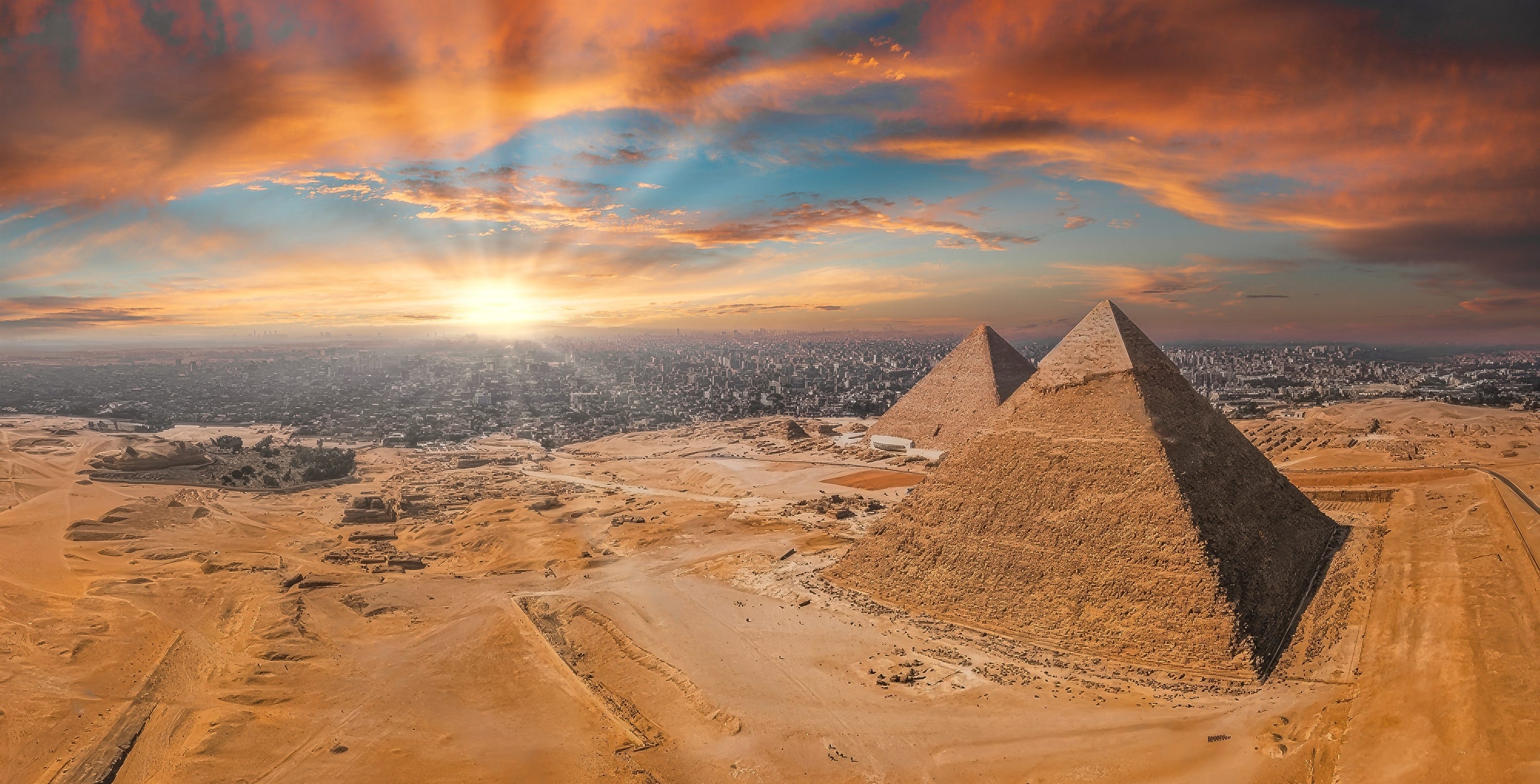
The Great Pyramid and the monuments that came after are the oldest surviving example of what we call “monumental architecture”—buildings which are much more elaborate in size or design than practicality requires. The less necessary and useful the pyramids were, the more they testified to the unfettered power of their builders.
Or, in the words of archaeologist Bruce Trigger, “The ability to expend energy, especially in the form of other people’s labour, in non-utilitarian ways, is the most basic and universally understood symbol of power.”
Just consider that for a moment.
Some of the expenditure of energy going into the current building projects comes directly from the people, in the form of tax money. Some of it is coming from businessmen and entrepeneurs who hope for favors from the administration. This, too, is other people’s labour.
And no matter what Trump says, a ballroom—not to mention a triumphal arch—is a non-utilitarian building, no more practical than a great pyramid, that will stand as a monument not to the greatness of the American experiment but to the power of one particular man to use the labor of others for himself.
“One battle after another: Trump’s war on federal archicture.” https://www.theartnewspaper.com/2026/02/02/trump-war-on-federal-architecture
“Trump wants to build a 250-foot-tall arch, dwarfing the Lincoln Memorial.” https://wapo.st/3OfjDWP
“Trump Steaks, Trump University, Trump International Airport? This Has to Stop.” https://www.nytimes.com/2026/02/10/opinion/trump-university-airport.html?unlocked_article_code=1.NFA.Gu1w.D-vLmXWRLbHO&smid=url-share
"The History of the Ancient World. https://bookshop.org/p/books/the-history-of-the-ancient-world-from-the-earliest-accounts-to-the-fall-of-rome-susan-wise-bauer/c4cf9eda643daa4b?ean=9780393059748&next=t
Ozymandias comes to mind, although I strongly doubt there will be even a broken-off trunk of a statue bearing Trump’s name in a few thousand years.